
You both get paid, the bills get paid, but somehow the question of “where did the money go?” still hangs in the air every month. Maybe it’s a vague unease after a grocery run, or a minor tension when the utility bill arrives. For couples, roommates, and families managing shared finances, this lack of clarity is a common source of low-grade stress that can erode trust. The solution isn’t another budgeting app that one person ignores or a complex system of receipts on the fridge. It’s a single, shared household budget spreadsheet—a transparent, central source of truth you build and maintain together. This simple tool transforms financial management from a solo chore into a collaborative act, replacing guesswork and arguments with clarity and teamwork.
The best way to organize a shared household budget is to create a single spreadsheet with dedicated tabs for your monthly budget, a running transaction log, and a summary dashboard. Start by agreeing on shared expense categories and contribution ratios, then log every transaction in one place. Schedule a weekly 15-minute ‘money date’ to update it together, which builds transparency and prevents financial surprises.
Your Shared Budget Toolkit: The 3 Essential Tabs
Think of your shared household budget spreadsheet not as one massive, confusing sheet, but as a simple toolkit with three distinct, purpose-built tabs. This separation of duties is what keeps the system clean, manageable, and collaborative. Each tab has a single job, and data flows logically from one to the next.
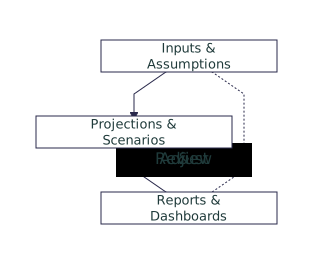
1. The Budget Plan (Your Map)
This is your static monthly blueprint. Created once and tweaked occasionally, it lists all your shared income and agreed-upon spending categories with target amounts. It answers the question: “Where do we plan for our money to go?” This tab informs your expectations and is the reference point for your family budget spreadsheet organization.
2. The Transaction Log (Your Travel Diary)
This is the dynamic, living record of every single shared financial move. Every grocery run, utility bill, and date night expense gets logged here with its date, amount, category, and who paid. This is the raw data feed for your entire system. A well-maintained log turns a static plan into a powerful joint budget tracker.
3. The Dashboard (Your Compass)
This is your at-a-glance summary. Using simple formulas, it pulls data from the Log to show your actual spending versus your Budget Plan for each category. It tells you, in real-time, if you’re on track or if you need to adjust course. This tab provides instant transparency and is the key to preventing financial surprises.
Setting Up Your First Tab: The Monthly Budget Plan
Before you log a single transaction, you need a plan. Setting up your Budget Plan tab is a collaborative exercise that forces important conversations. Here’s a mini-checklist to guide you through the foundational decisions.
- Define “Shared” vs. “Personal.” This is the most critical step. Is the internet bill shared? What about streaming subscriptions or pet food? Get clear on what expenses belong in this joint household budget to avoid confusion later. Personal expenses (like a gym membership or a hobby) typically stay off this sheet.
- Choose a Contribution Method. How will you both fund the shared pot? Common methods are a straight 50/50 split, a proportional split based on income, or a fixed amount from each person. Agree on what feels fair and sustainable for your situation.
- List All Income & Fixed Expenses. In your spreadsheet, list every source of shared monthly income. Then, list every fixed, predictable shared bill (rent, car payment, insurance). These numbers are your foundation.
- Create Variable Spending Categories. Now, list the flexible spending categories like Groceries, Dining Out, Home Supplies, and Fun Money. Assign a realistic target amount to each based on past spending or a new goal.
This tab isn’t about perfection; it’s about creating a shared financial target you can both see and agree on, which is the core of good family budget spreadsheet organization.
The Weekly Routine: How to Keep It Alive
The most beautiful family finance spreadsheet is useless if it collects digital dust. The magic isn’t in the setup—it’s in the habit. The solution is the “Weekly Money Date”: a scheduled, 15-minute block where you update the spreadsheet together.

Here’s how it works: Gather any receipts from the week or pull up your joint bank account transactions. Together, open the Transaction Log tab and enter each shared expense. Categorize it, note who paid, and let the formulas do the rest. Then, take 30 seconds to glance at the Dashboard. Are you over budget on dining? Under on groceries? This isn’t a blame session; it’s a quick, factual check-in that builds teamwork.
Imagine it’s a busy Wednesday. One of you paid the electric bill online, and the other grabbed groceries. Instead of a text asking “Did you pay the bill?” or a forgotten receipt at the bottom of a bag, you both know it will be logged and sorted during your regular Friday evening check-in. This tiny habit eliminates the mental load of tracking who paid for what and prevents those small financial ambiguities from becoming arguments.
Consistency here is far more important than perfection. Missing a week is fine; just catch up the next time. This routine transforms your spreadsheet from a static document into a living, breathing collaborative budget tool that actually works.
Common Spreadsheet Pitfalls (And How to Avoid Them)
Even with the best intentions, shared budget systems can fizzle out. Recognizing these common traps upfront can help you steer clear of them.
Pitfall: Over-Complicating Categories.
Solution: Start with broad categories (e.g., “Groceries,” “Household,” “Entertainment”). You can always split “Groceries” into “Food” and “Household Supplies” later if needed. Beginning with 30 hyper-specific categories is a fast track to abandonment.
Pitfall: The “Gray Area” Expense.
Solution: Revisit your “Shared vs. Personal” definition. If an expense consistently causes confusion (e.g., “Was that takeout dinner for just you or for both of us?”), create a clear rule for it. Better yet, have a small, pre-agreed “Personal Spending” allowance for each person to cover these gray areas without debate.
Pitfall: Inconsistent Updating.
Solution: This is why the Weekly Money Date is non-negotiable. Put it on the calendar like any other important appointment. Letting receipts and transactions pile up for a month makes the task feel overwhelming and defeats the purpose of a real-time shared expense tracker.
Pitfall: Using It as a Weapon.
Solution: The dashboard shows facts, not fault. Frame conversations around the category (“Our ‘Dining Out’ budget is tapped out”) not the person (“You spent too much on restaurants”). The goal is to solve problems together, not to keep score.
Clarity, Not Perfection
The ultimate goal of your shared household budget spreadsheet isn’t to create a flawless financial model or to restrict your life. It’s to build clarity and trust. By moving money conversations from vague worries and forgotten receipts into a clear, shared space, you replace anxiety with alignment.
Start simple. Use the three-tab toolkit to build your foundation, and protect the weekly routine that keeps it alive. Your first version won’t be perfect, and that’s okay. The real win is the open communication and financial teamwork you’ll develop by refining the system together, one money date at a time.
Q: Can we use Google Sheets or Excel?
A: Absolutely. For most couples and roommates, Google Sheets is ideal because it’s free, accessible from any device, and allows for real-time collaboration—you can both be in the sheet at the same time. Excel works perfectly if you prefer a desktop-only solution. The principles and structure are identical.
Q: What if our incomes are very different?
A: A proportional split is often the fairest approach. If one person earns 70% of the total household income, they contribute 70% to the shared budget. This ensures shared financial goals are met without placing an unequal burden on the lower-earning partner. The key is to have an open conversation and agree on what feels equitable for your partnership.
Q: How do we handle personal spending from a joint account?
A: The cleanest method is to have a dedicated “Personal Allowance” category in your shared budget. Each month, an agreed-upon amount is transferred (on paper or in reality) to each person for completely discretionary, no-questions-asked spending. This keeps personal purchases out of the shared transaction log and prevents minor spending from becoming a point of discussion.
Q: What if one person is less tech-savvy?
A: Keep the spreadsheet extremely simple and do the weekly update together. The less tech-savvy person can be in charge of gathering receipts or reading off transactions from a bank statement, while the other handles data entry. Over time, the process will become familiar. The goal is shared understanding, not spreadsheet expertise.