
You know the scene. It’s the end of the month, and a small pile of envelopes and digital reminders sits on the counter, silently judging you. You pay them, of course, but there’s that familiar, low-grade anxiety—did you miss one? Is your timing off? The problem isn’t a lack of effort; you’re trying to be organized. The real issue is often a mismatch between your natural thinking style and the bill organization tool you’re using. Choosing between a bill calendar vs bill checklist isn’t about finding the “best” system in a vacuum. It’s about discovering which method aligns with how your brain works, turning a chore into a seamless part of your financial routine.
The best way to organize your bills depends on your cognitive style. A bill calendar is superior for visual thinkers who need to see due dates in the context of a month and manage cash flow timing. A bill checklist is better for linear, task-oriented people who get satisfaction from checking items off a list and executing payments in a set order. Choose based on whether you think in dates or tasks.
The Bill Calendar: A Visual Timeline for Your Money
A bill calendar is exactly what it sounds like: a calendar, digital or physical, where you mark the due dates for every single payment. Its superpower is visualization. Instead of a jumble of dates in your head, you see your entire month’s financial obligations laid out on a timeline. This makes it a powerful payment tracking system for anyone who needs to understand how bills interact with their income schedule. powerful payment tracking system
The ideal user for this method is a visual thinker. If you get a clearer picture by seeing things mapped out in space and time, a calendar is your ally. It answers the critical cash flow question: “Do I have enough money in my account before this bill is due?” Popular tools include Google Calendar, Apple Calendar, or dedicated bill due date tracker apps. Even a classic paper wall calendar can work wonders.
Pro tip: For maximum clarity, color-code your entries. Use red for utilities, blue for subscriptions, and green for debt payments. This turns your calendar into an instant, at-a-glance financial dashboard.
The Bill Checklist: A Linear Path to ‘Done’
A bill checklist is a simple list of every bill you need to pay, typically in a given month. It can live in a notes app, a task manager like Todoist, or on a piece of paper stuck to the fridge. Its core strength is linearity and task completion. It provides a clear, sequential action plan and delivers the undeniable psychological reward of checking a box.
This system is perfect for the task-oriented person. If you thrive on executing a clear set of steps and get a little burst of satisfaction from marking something “done,” a checklist aligns with your workflow. It’s less about visualizing the month and more about conquering a set of chores. A well-structured monthly bill checklist acts as a reliable payment reminder system, ensuring no bill is ever overlooked because it wasn’t on the list.
Pro tip: Order your checklist by due date (earliest to latest) or even by payment amount (smallest to largest) to create a predictable, stress-free payment routine you can follow without second-guessing.
Side-by-Side: Key Decision Points
So, how do you choose? Let’s break down the key differences between these two financial organization tools.
Thinking Style: Calendars cater to visual, spatial, and date-based thinking. You see the “when.” Checklists cater to linear, sequential, and task-based thinking. You follow the “what.”
Handling Variable Dates: A calendar excels here. If a due date changes, you move one entry. On a static checklist, you might have to re-write or re-order the entire list, which can introduce errors.
Cash Flow Management: This is the calendar’s domain. By seeing due dates alongside your paydays, you can proactively plan for tight weeks. A checklist shows what’s due, but not as clearly in the context of your income timeline.
Psychological Payoff: The checklist offers the quick win of checking off a task. The calendar offers the peace of mind of seeing an empty, scheduled future—knowing everything is planned for.
Photo by Tara Winstead on Pexels
Which System Is Your Financial Personality?
Let’s make this practical with two scenarios. See which one feels more familiar.
The Visual Planner: You feel a knot in your stomach when you think about your credit card payment and your mortgage coming out in the same week your car insurance renews. You need to see the whole month mapped out to feel in control and ensure your paycheck lands before the big withdrawals. You think in terms of timelines and gaps. If this is you, try a bill calendar.
The Taskmaster: You don’t necessarily forget bills exist, but you might forget to execute the payment because it wasn’t on today’s “to-do” list. You love the clarity of a simple list and the concrete action of logging into an account, paying, and checking it off. Your goal is a clear, repeatable process. If this is you, try a bill checklist.
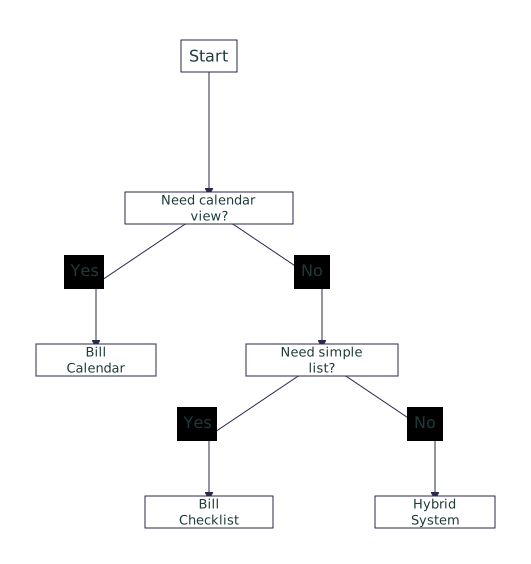
Still unsure? The flowchart above can help guide your choice based on your natural preferences. Remember, the goal is to match the tool to how your brain already works, not to force your brain to adapt to a rigid tool.
Finding Your Fit for Effortless Organization
The real answer to the “bill calendar vs bill checklist” debate isn’t about which tool is objectively better. It’s about which one is better for you. The right system feels less like a chore and more like a natural extension of how you think. A calendar won’t help a dedicated task-lover, and a checklist might frustrate a visual planner.
The tradeoff is clear: calendars give you the big-picture timeline, while checklists give you the satisfying step-by-step control. Neither is perfect for everyone, but one is perfect for your financial personality.
Your call to action is simple. Pick one method—just one—and commit to using it for your next billing cycle. Set it up, populate it with your bills, and use it. The reduction in mental load and late-payment anxiety will quickly tell you if you’ve found your fit.