
You open your budgeting app, ready to log a simple grocery run, and you’re immediately paralyzed. The list of spending categories scrolls on and on: “Groceries – Main,” “Groceries – Bulk,” “Dining Out – Fast Casual,” “Dining Out – Sit Down,” “Coffee – Chain,” “Coffee – Local,” “Entertainment – Streaming,” “Entertainment – Movies,” “Subscriptions – Music,” “Subscriptions – News.” What started as a tool for clarity now feels like a cage of your own making, demanding a level of granularity that’s exhausting to maintain. This is budget complexity fatigue—the point where your system, designed to empower, instead overwhelms. The good news is that your budget doesn’t have to be a source of stress. A strategic budget category cleanup is the path forward, transforming your rigid spreadsheet or app into a flexible, intuitive framework that actually works with your life, not against it.
Budget category cleanup is the strategic process of reviewing and consolidating your spending categories to reduce complexity and increase usability. The best approach starts by identifying what your current system is making you do that you want to stop. It’s about auditing your existing lines, merging similar ones, and renaming them into intuitive buckets that reflect how you actually live and spend. The goal is to create clarity and ease of use, not to enforce deprivation or track every last penny.
Why Your Over-Complicated Budget is Failing You
That initial burst of enthusiasm for detailed tracking can lead to a common trap: a budget with so many lines that it becomes a source of stress, not a tool for clarity. This isn’t a failure of willpower; it’s a design flaw. An over-engineered budget creates friction at every step, making it harder to maintain the very system meant to help you.

The primary issue is decision fatigue. When you have 15 different categories for food (Groceries, Farmer’s Market, Coffee Shop A, Coffee Shop B, Fast Food, Sit-Down Restaurants, Work Lunches…), every transaction requires a mini-decision. This mental tax makes you more likely to skip logging a purchase or to dump it into a “Miscellaneous” black hole, breaking your tracking system. Furthermore, excessive granularity can create a false sense of control. You might feel productive managing 50 categories, but if you can’t see the forest for the trees—like your total discretionary spending—you’re not gaining actionable insight.
Signs Your Budget Needs a Cleanup
- You have separate categories for specific stores or brands (e.g., “Amazon,” “Target,” “Starbucks”).
- You regularly forget which category you created for a common expense.
- You feel a sense of dread or annoyance when it’s time to log transactions.
- Your budget has more than 25-30 active categories.
- You’ve created a “Miscellaneous” or “Other” category that consistently grows.
This “budget complexity fatigue” is what we aim to solve. The goal isn’t to track less, but to track smarter by organizing spending categories into a logical framework that reduces daily friction.
The Core Principles of a Simplified Budget
Before we dive into the tactical steps, it’s crucial to shift your mindset. A simplified budget isn’t about being lazy with your money; it’s about being strategic with your attention. The guiding philosophy rests on three core principles that contrast sharply with the “perfect tracking” approach.
First, clarity over granularity. Your budget should give you an immediate, high-level understanding of where your money goes. Can you see your total “Lifestyle” spending at a glance, or is it buried across eight sub-categories? The aim is to streamline budget categories into broader “buckets” or “category families” that reflect your financial priorities, not every individual vendor.
Second, flexibility over rigidity. Life isn’t static, and neither should your budget be. A simple system with broader categories inherently has more wiggle room. If you spend less on dining out one week, that money naturally stays in your “Food & Dining” bucket for groceries or a future meal, without requiring you to move funds between 10 micro-categories.
Finally, alignment with actual behavior. Your budget should describe your real financial life, not an idealized version of it. If you consistently spend on streaming services, that’s a “Subscriptions” line, not something to hide or feel guilty about. This principle is about creating a truthful map, which is the first step toward any intentional change. By adopting these principles, you set the stage for a sustainable system built on practical money habits.
The Cleanup Process: Audit, Merge, and Name
This is the hands-on, how-to heart of simplifying your budget. We’ll break it down into three sequential phases: Audit, Merge, and Name. Think of it as decluttering a closet—you first need to see everything you have (Audit), then group similar items together (Merge), and finally label the shelves so you can find things easily (Name).
Phase 1: The Audit
Gather your last three months of bank and credit card statements. The goal is empirical: identify what you actually spend money on, not what you think you do. As you review, mark categories that were used fewer than twice in the three-month period. These are prime candidates for merging. Also, note any surprises—spending patterns you didn’t account for. This audit isn’t about judgment; it’s about gathering data to organize spending categories effectively.
Phase 2: The Merge
Here’s where you consolidate spending categories. Apply these practical rules:
- Merge by Vendor Type: All streaming services (Netflix, Hulu, Spotify) become “Subscriptions.” All coffee shops, fast food, and restaurants become “Dining Out.”
- Merge by Life Domain: Gas, tolls, public transit, and ride-shares can become “Transportation.” Haircuts, toiletries, and skincare can become “Personal Care.”
- Cap Your Categories: Aim for 10-15 core categories. A helpful framework is Needs (housing, utilities, groceries), Lifestyle (dining, entertainment, subscriptions), Goals (savings, debt extra payments), and Future (investments, irregular expenses fund).
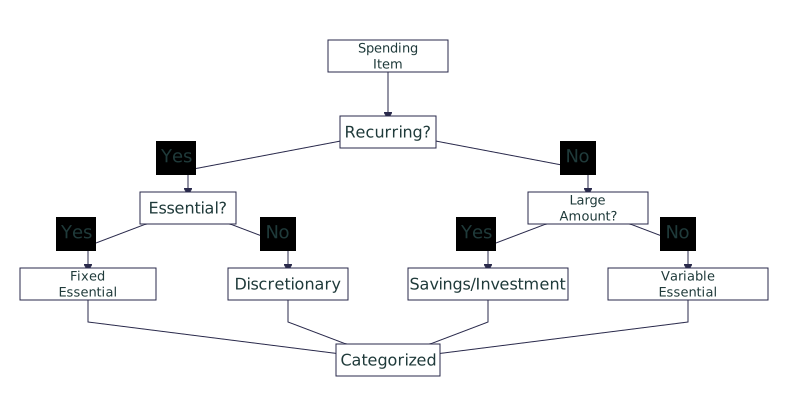
Scenario: Imagine you have “Work Lunches,” “Date Night,” “Fast Food,” and “Coffee.” Under the new system, you’d merge all four into a single “Dining Out” category. This doesn’t mean you can’t mentally note the difference, but for budgeting purposes, the total spent on food outside the home is the key insight.
Phase 3: The Rename
Names matter. Use intuitive, behavior-focused language for your new, broader categories. Instead of “Discretionary – Entertainment,” try “Fun Money.” Instead of “Utilities & Services,” try “Home Operations.” Good names make the category’s purpose instantly clear, reducing mental load every time you log a transaction. This final step solidifies your new, streamlined system.
Common Pitfalls to Avoid When Simplifying
In the zeal to declutter, it’s easy to overshoot. Avoiding these common mistakes will help you create a system that’s simple but still insightful.
1. Creating a “Miscellaneous” Black Hole
The biggest mistake is funneling too many unrelated expenses into a catch-all “Miscellaneous” or “Other” category. This destroys the clarity you’re working to achieve. If a category consistently gets used, it deserves a real name. A better approach is to have a small “Slush Fund” for truly unpredictable, minor expenses, but keep it capped at a low dollar amount.
2. Merging Discretionary and Non-Discretionary Spending
Combining “Electric Bill” and “Dining Out” into a single “Spending” category removes your ability to prioritize. Core, fixed needs should be separate from flexible, discretionary wants. This separation is crucial for making tough decisions if you need to cut back.
3. Forgetting True Spending Drivers
When you merge, don’t just think about the type of purchase, think about the driver. For example, “Books” and “Video Games” might both be “Entertainment,” but if book-buying is a significant, consistent hobby for you, it might warrant its own “Hobbies” line to give you better visibility. The goal is to refine budget groupings for your life, not to follow a generic template.
4. Ignoring Irregular Expenses
Annual subscriptions, car registration, holiday gifts—these aren’t monthly, but they are predictable. A simplified budget must account for them. The solution is to create a “Sinking Fund” or “Irregular Expenses” category and contribute a small, fixed amount to it each month, so the money is there when the bill arrives.
Making Your New, Simpler Budget Stick
You’ve audited, merged, and renamed. Now, how do you ensure this cleaner system lasts? Implementation is key. Start by updating your budgeting app or spreadsheet with the new category list. You may need to recategorize some past transactions to keep reports clean, but focus on moving forward.
Commit to a 30-day review period. Use this month to test-drive your new categories. At the end of the month, ask yourself: Was it easier to log transactions? Do I have a clearer picture of my spending? Does any category feel too broad or too restrictive? Give yourself explicit permission to tweak. The system works for you, not the other way around.
Your First-Month Maintenance Checklist
- Log transactions promptly to test the intuitiveness of your new category names.
- Check category balances mid-month to see if your allocations feel realistic.
- Note any transaction that made you pause about where to put it—this signals a category that might need adjusting.
- Celebrate the reduced friction instead of fixating on perfect adherence.
Remember, a budget is a living document. The ultimate goal of this budget category cleanup is to spend less mental energy on tracking mechanics and more on making intentional choices that align with your goals. You’ve optimized expense categories for usability, which is the foundation of long-term financial awareness.
Your Budget, Liberated
The journey from a cluttered, overwhelming budget to a clear, functional one is fundamentally about reclaiming your time and mental space. By intentionally simplifying your categories, you’re not abandoning control—you’re designing a system that grants you higher-level control, focused on your priorities rather than pennies. A good budget shouldn’t feel like a cage of restrictions, but like a map that gives you the confidence to navigate your financial life. When your budget is simple, it becomes a tool for freedom, empowering you to spend (and save) with purpose and far less daily stress.
Simplifying your budget is a strategic process to reduce friction and increase insight. Start with an Audit of 3 months of actual spending to identify rarely used categories. Then, Merge similar expenses into broader buckets (like combining all streaming services into “Subscriptions”) aiming for 10-15 core categories. Finally, Name your new categories with intuitive, behavior-focused language. Avoid common pitfalls like over-using “Miscellaneous” or merging needs with wants. Implement your new system with a 30-day trial, giving yourself permission to adjust until it feels clear and sustainable. The goal is a budget that provides clarity with minimal daily effort.