If you’ve ever tried to budget, you’ve probably heard the advice: you need dozens of detailed categories to succeed. The promise is that tracking every coffee, snack, and streaming service will give you ultimate control. But for most people, that level of granularity doesn’t lead to clarity—it leads to a complex spreadsheet, decision fatigue, and a budget that’s abandoned by the second week of the month. The truth is, effective budget category grouping isn’t about creating more boxes to check; it’s about creating a simpler mental framework that aligns with how you actually live and spend. The most sustainable system moves beyond basic needs versus wants and focuses on three intuitive buckets: Fixed (your non-negotiable bills), Flexible (your variable essentials), and Fun (your guilt-free discretionary spending). This approach reduces friction by clarifying what your money is truly for, making it easier to stick with a plan that feels empowering, not restrictive.
The best way to group your budget category grouping is to use a simple three-bucket system: Fixed (non-negotiable bills), Flexible (variable essentials), and Fun (pure discretionary spending). This method reduces decision fatigue by clarifying what money is truly available for choices, making budgeting more sustainable than complex, granular tracking. Start by listing all your monthly expenses and sorting them into these three mental buckets.
The Problem with Over-Engineering Your Budget
Many people believe that to truly master your money, you need a spreadsheet with 30, 40, or even 50 separate budgeting categories. You track “groceries,” “coffee,” “snacks,” “dining out,” “fast food,” and “work lunches” as distinct line items. The promise is that this granularity gives you ultimate control. separate budgeting categories
The reality is it often gives you burnout. This over-engineering creates decision fatigue every time you log a $4 coffee. Was that “Coffee” or “Fun Money”? It blurs the lines between essential and discretionary spending, making the whole process feel restrictive and confusing. When budgeting feels like a chore, it’s the first thing we abandon.
The solution isn’t more tracking; it’s smarter grouping. A simple framework with just three mental spending buckets—Fixed, Flexible, and Fun—shifts the focus from micromanaging pennies to understanding the behavior behind your spending. This clarity, not complexity, is what leads to lasting control.

Photo by Pavel Danilyuk on Pexels
Fixed Spending: Your Financial Foundation
Your fixed spending categories are the non-negotiable pillars of your monthly cash flow allocation. These are expenses where both the amount and the due date are highly predictable. Think of this bucket as your “set and forget” financial foundation.
Common examples include:
- Rent or mortgage payment
- Car payment
- Student loan payment
- Insurance premiums (car, health, renters)
- Minimum debt payments
- Subscriptions with fixed monthly rates (like streaming services or your phone bill)
This money is spoken for before the month even begins. To handle bills that aren’t monthly (like annual car registration or semi-annual insurance), divide the yearly cost by 12 and “save” that amount each month into a separate holding account, treating that monthly savings transfer as a Fixed expense. The key takeaway: this bucket gets funded first, as it represents your core financial commitments.
Flexible Spending: The Realm of Real Choices
This is where your variable spending categories live, and it’s the most impactful zone for mindful money management. Flexible spending covers essential needs where the exact amount can vary from month to month.
These are your true essentials:
- Groceries
- Gasoline / public transit
- Utilities (electric, water, gas—even if they fluctuate)
- Household goods (toilet paper, cleaning supplies)
- Basic personal care (shampoo, haircuts)
Instead of assigning a rigid number to “groceries,” you allocate a total monthly pool for all Flexible expenses. Here’s the powerful part: if you spend less on groceries one week, that money remains in the Flexible pool for other needs (like a higher electric bill) or can be rolled over. This creates a natural buffer and rewards conscious spending without the guilt of “stealing” from another tiny category. It clearly separates essential variables from pure discretionary spending.
Fun Spending: The Guilt-Free Zone
This is the fun money category, and it is critical for a sustainable budget. Fun spending is pure, guilt-free discretionary spending—money for the things that make life enjoyable but are not essential for living or working.
This includes:
- Dining out & takeout
- Entertainment (movies, concerts)
- Hobbies
- New clothes (beyond basic replacement)
- Impulse purchases
By giving this category its own named bucket—and funding it intentionally, not with whatever is “leftover”—you accomplish something powerful. You remove the guilt from enjoying your money. That coffee shop visit comes from the “Fun” pool, not the “Groceries” pool, so there’s no internal debate or shame. This separation is what makes a budget feel empowering rather than punitive, turning it into a tool for funding your life, not just restricting it.
Making the System Work for You: A Practical Walkthrough
Now, let’s apply this money management framework. Start by listing every single monthly expense from your bank statements. Your first job is to sort each one into Fixed, Flexible, or Fun. Most will be obvious, but you’ll hit some gray areas—that’s normal and part of personalizing the system.
Navigating the Gray Areas
Is a gym membership Fixed or Fun? If you go consistently and it’s a non-negotiable part of your health routine, calling it Fixed makes sense. If it’s sporadic and more of a leisure activity, it’s Fun. Is a “nice” haircut Flexible (basic care) or Fun (a luxury treat)? You decide. The goal is to create categories that reflect your values and behavior, not to find a single “right” answer.
Allocating Your Money
You can use percentages (e.g., 50% Fixed, 30% Flexible, 20% Fun) or flat dollar amounts. There’s no perfect ratio; it depends on your income and obligations. The key is to ensure your Fixed and Flexible buckets are covered, then consciously decide how much goes to Fun.
Choosing a Tracking Method
You can use a simple notebook with three columns, a basic spreadsheet, or a budgeting app that allows for this three-bucket expense grouping system. The tool matters less than the mental model.
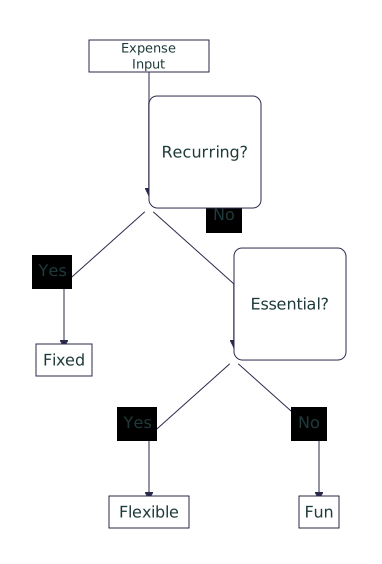
Start simple. Expect to move a few items between buckets in your first few months as you learn what each category truly means for your life. This flexibility is a feature, not a bug.
A Simpler Path to Financial Clarity
The goal of budget category grouping isn’t perfect accounting; it’s clearer awareness and reduced stress. By adopting the Fixed, Flexible, and Fun framework, you move away from frustrating granularity and toward an intuitive understanding of where your money goes. You’ll know what’s truly non-negotiable, where you have room to maneuver, and how much you can freely enjoy.
Remember, your first attempt won’t be perfect. You might mis-categorize an expense or need to adjust your allocations. That’s not failure—it’s the process of tailoring a system to fit your unique life. Start with these three buckets. Keep it simple, be kind to yourself, and watch as this straightforward approach makes managing your money feel more sustainable and, yes, even a little more fun.