
Let’s start by clearing the air on a common myth: organizing your sinking funds requires complex spreadsheets, a dozen separate bank accounts, and the kind of constant maintenance that makes you want to give up before you even start. This intimidating picture is exactly why so many people put off building this powerful financial tool. The reality is far more liberating. A sinking fund organization guide isn’t about creating a perfect, intricate system; it’s about building a simple, personalized one that you’ll actually use. This guide is designed to cut through the overwhelm and show you, step-by-step, how to set up a sinking fund system that brings you peace of mind instead of stress, turning unpredictable expenses into planned-for, manageable events.
A sinking fund is simply money you set aside each month for a specific future expense. The best way to organize them is to create a simple, personalized system you’ll stick with, not a complex one you’ll abandon. Forget about perfection; focus on a practical method that fits your life, whether that’s using a budgeting app, a single high-yield savings account with sub-accounts, or even old-fashioned cash envelopes. The goal is consistency, not complexity.
Myth vs. Fact: What Sinking Fund Organization Really Means
Before we dive into the practical steps, let’s clear the air. Many people get stuck before they even start because they believe a few common myths about what it takes to organize sinking funds. Let’s replace those intimidating ideas with the simple, flexible truth.
Myth 1: You Need a Separate Bank Account for Each Fund
Fact: This is the fastest route to overwhelm and a cluttered banking dashboard. While you can open multiple accounts, you absolutely don’t have to. The core principle is mental or digital separation, not physical separation. A single high-yield savings account with clear labels in your bank’s “nickname” field, or a budgeting app with virtual envelopes, works perfectly for most people. The goal is to know what each dollar is for, not to give every dollar its own home address.
Myth 2: It Requires Advanced Spreadsheet Skills
Fact: Your system can be as simple as a piece of paper in a folder or a basic note on your phone. If you love spreadsheets, great! But if the thought of formulas gives you anxiety, you can skip it entirely. The best system is the one you’ll actually look at and maintain. For a clear, spreadsheet-free explanation of the core concept, resources like NerdWallet’s guide to sinking funds break it down in plain language.
Myth 3: It’s Only for Big-Ticket Items Like Vacations or a New Car
Fact: Sinking funds are incredibly powerful for smoothing out those smaller, annoying irregular expenses that wreck a monthly budget. Think: annual software subscriptions, quarterly pet meds, semi-annual haircuts, or even your yearly Amazon Prime renewal. By saving for these in small monthly chunks, you turn a surprising $120 hit into a predictable $10 monthly line item. That’s the real magic of organizing your sinking funds—it brings peace to your everyday finances.
Your First Step: Brainstorming Your Sinking Fund Categories
Now for the fun part: figuring out what you’re actually saving for. Grab a notebook, a notes app, or even a napkin. We’re going to do a quick brain dump of all the expenses that don’t fit neatly into your “rent” or “groceries” category. Don’t overthink it; just list anything that pops up irregularly throughout the year.
Start by looking at your bank statements from the last 12 months. What one-off charges showed up? Then, look ahead. What do you know is coming? Finally, what would you like to be ready for? This process is the foundation of your personalized sinking fund categories.

Photo by www.kaboompics.com on Pexels
Starter Category List for Inspiration
If you’re drawing a blank, here are common categories to get your wheels turning:
- Car Care: Oil changes, new tires, registration, repairs.
- Home & Family: Holiday gifts, birthdays, back-to-school supplies, minor home repairs.
- Personal Care: Dental work, new glasses, haircuts, gym membership annual fee.
- Pet Costs: Annual vet check-ups, vaccinations, flea/tick medication.
- Subscriptions & Fees: Amazon Prime, domain hosting, professional memberships.
- Fun Money: Weekend getaways, concert tickets, hobby upgrades.
Your list will be unique to you. The key for beginner sinking funds is to start with 3-5 categories that feel most urgent or stressful.
Choosing Your System’s ‘Home’: Physical vs. Digital
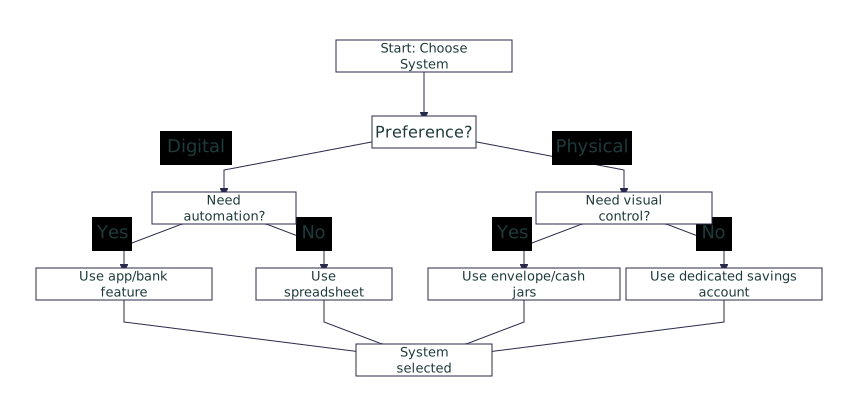
This is the most important decision in your sinking fund setup for beginners. Where will you physically (or digitally) keep this money? The right choice depends entirely on your personality and how you interact with money. There is no “best” option, only the best one for you.
Option 1: Separate High-Yield Savings Account (HYSA)
Best for: The “set-and-forgetter” who loves automation. You open one (or maybe two) savings accounts at an online bank known for good interest rates. You use the bank’s “nickname” feature to label sub-accounts or simply track the totals for each category in a note. Set up automatic monthly transfers and let it grow with minimal effort.
Consider this: It’s highly automated and earns interest, but requires a tiny bit of manual tracking if you use a single account for multiple funds.
Option 2: Budgeting App Envelopes
Best for: The hands-on tracker who uses a budgeting app like YNAB (You Need A Budget), Goodbudget, or EveryDollar. These apps are built around the envelope system, making it intuitive to create digital “envelopes” for each sinking fund category and assign dollars to them.
Consider this: It provides incredible clarity and real-time tracking, but usually requires a subscription fee and regular app engagement.
Option 3: The Classic Cash Envelope System
Best for: The tactile learner who spends primarily in cash or needs the physical constraint to stick to a plan. You withdraw cash each month and divide it into literal envelopes labeled for each category.
Consider this: It’s supremely simple and prevents overspending, but isn’t practical for online bills, doesn’t earn interest, and requires keeping cash secure.
Option 4: The Simple Spreadsheet or Notebook
Best for: The minimalist who wants total control without extra accounts or apps. You keep all your money in one or two checking/savings accounts and use a spreadsheet or notebook to record how much is earmarked for each category. You simply update the balances as you add or spend money.
Consider this: It’s free and completely flexible, but relies 100% on your manual discipline to update and reconcile.
Here’s a common experience: Someone starts with a complex app, creates 15 detailed categories, and feels motivated for two weeks. Then life gets busy, they forget to log a transaction, and the whole system feels like a failure. They give up. Later, they try the simple HYSA method, set up one automatic transfer for their top 3 sinking fund categories, and find a sustainable peace they never had with the “perfect” app. The lesson? Match the system to your real life, not an ideal.
The Simple Setup: Your Action Plan
Let’s turn theory into action. Follow these straightforward steps to build your organized system in under an hour. This is your practical sinking fund management guide.
- Finalize Your Shortlist. Review your brainstorm. Pick 3-5 sinking fund categories to start with. You can always add more later.
- Choose Your “Home.” Based on the section above, decide on your method: one HYSA, a budgeting app, cash envelopes, or a spreadsheet.
- Open Accounts or Create Envelopes. If you chose a separate savings account, open it now. If you chose an app, download it and create your category envelopes. If cash, get your envelopes ready.
- Name Them Clearly. Use specific, motivating names. “Car Maintenance Fund” is better than “Car Stuff.” “2025 Beach Vacation” is better than “Travel.”
- Determine Your Monthly Funding Goal. For each category, estimate its total annual cost and divide by 12. (e.g., $600 for holidays / 12 months = $50/month). Don’t strive for perfect accuracy; a good estimate is fine.
- Set Up Automatic Transfers. This is the most critical step for success. Log into your bank and schedule a recurring transfer from checking to your sinking fund account for the total monthly amount, or set up allocations in your app. Automate it so you don’t have to remember.
- Schedule a Monthly Check-In. Put a 10-minute reminder on your calendar to review your sinking funds. Ensure transfers happened, adjust goals if needed, and celebrate the growing balances!
That’s it. You’ve just built a simple sinking fund organization system. The complexity is gone, leaving only a process that works quietly in the background for you.
Common Sinking Fund Organization Pitfalls (And How to Skip Them)
Even with the best intentions, it’s easy to stumble. Here are the most frequent mistakes people make when organizing your sinking funds, and how you can gracefully avoid them.
Pitfall: Creating Too Many Categories
You get excited and create a fund for “Christmas,” “Birthdays,” “Anniversaries,” “Valentine’s Day,” and “Just Because Gifts.” Soon, you’re managing 15 tiny funds with $5 going to each, which feels pointless and complicated.
Skip It: Consolidate! Group similar expenses. One “Gifts & Celebrations” fund covers all of the above. Start broad. You can always split a category later if it becomes a significant enough expense on its own.
Pitfall: Failing to Fund Them Consistently
You set up the categories but treat them as an afterthought. When the month is tight, you skip the transfer, promising to “catch up next month.” You never do, and when the expense hits, the money isn’t there.
Skip It: Automate the transfer on payday. Treat it like a non-negotiable bill. If you use cash, make “funding the envelopes” the first thing you do after getting cash.
Pitfall: Raiding the Funds for “Emergencies”
Your car tire fund has $200 in it, and you see a great deal on a new TV. You tell yourself you’ll “pay it back,” but that rarely happens, leaving you unprepared for the actual car repair.
Skip It: Define the purpose of each fund clearly. A sinking fund is for a planned irregular expense. A separate, general emergency fund is for true, unplanned emergencies. Keep them distinct. Out of sight (in a separate savings account) often means out of mind.
Pitfall: Choosing a System That Doesn’t Match Your Lifestyle
You hate apps, but you set up a digital envelope system because a finance guru said it was best. You abandon it within a month.
Skip It: Be ruthlessly honest about your habits. If you won’t log into an app daily, don’t build your system there. The perfect system is the one you use. Period.
Your Path to Financial Peace Starts Here
Remember, the goal of this entire sinking fund organization guide wasn’t to build a flawless system, but to build a functional one that gives you peace of mind. You don’t need perfection; you need a simple, automated process that quietly prepares you for life’s expected expenses so they stop feeling like emergencies.
Celebrate the small win of setting up that first automatic transfer. Trust that by consistently moving small amounts of money, you’re building a powerful buffer between you and financial stress. This is how you gain real confidence with your money—not by complex strategies, but by simple, sustained action.
Start where you are, use what you have, and begin. Your future self, facing a car repair or holiday season with calm instead of panic, will thank you.
Organizing sinking funds is about simplicity and personal fit, not complexity. The core takeaways are: 1) Bust the myths—you don’t need multiple accounts or advanced skills, just clear separation. 2) Start with a shortlist of 3-5 personal sinking fund categories that cause you stress. 3) Choose a “home” for your money (like a single high-yield account or a budgeting app) that matches your actual habits, not an ideal. 4) Automate your monthly contributions immediately to ensure consistency. By focusing on a system you’ll actually use, you turn budgeting for irregular expenses from a headache into a source of quiet confidence.