
You’ve set up the spreadsheet, logged into the app, and promised yourself this time will be different. Yet, within weeks, the whole thing feels like a tangled mess you’d rather avoid. The common wisdom says a messy budget is a math problem or a discipline failure, but that’s a myth. The real reason your budget feels messy and overwhelming isn’t about your willpower—it’s a predictable design flaw. Most budgeting systems are built like exhaustive audit logs, forcing you to track and categorize every single transaction. This creates immense psychological friction, decision fatigue from too many micro-choices, and a constant, demoralizing sense of being behind. The good news? A clean, sustainable budget isn’t about tracking more; it’s about designing a simpler system that works with your brain, not against it.
Your budget feels messy because it’s likely built on a flawed, overly complex tracking system designed for accountability, not clarity. The safest simplification method is to stop policing every penny and instead create simple financial guardrails. Shift your focus from tracking every detail to automatically protecting your 3-5 essential priorities (like rent, debt, and savings). What’s left becomes a single, guilt-free pool for everything else, monitored with a relaxed monthly check-in instead of daily scrutiny.
The Real Reason Your Budget Feels Like a Chore
Let’s clear something up right away: if your budget feels messy, it’s not a sign of personal failure. It’s a sign of a bad system. The most common budgeting approach—tracking every single expense across dozens of categories—is designed to create friction, not freedom.
The messiness you feel stems from three core psychological friction points. First, decision fatigue: every coffee or grocery trip becomes a mini-quiz on which of your 30 categories it belongs in. This constant micro-decision-making drains your mental energy for no real gain. Second, the system is built for “failure” tracking. When you overspend in one category, the entire spreadsheet lights up red, making you feel like you’ve broken the rules instead of just living your life. Finally, a rigid, hyper-detailed budget can never match the beautiful variability of real life. A surprise vet bill or a friend’s birthday dinner doesn’t fit neatly into a pre-set box, creating instant guilt and system breakdown.
In short, why your budget feels messy has little to do with math and everything to do with a design that fights human nature. It’s a tracking tool, not a guiding tool.
The Science of Simplicity: How Your Brain Wants to Budget
Cognitive science shows our brains crave simple, automatic systems over complex, manual ones. A budget based on exhaustive tracking imposes a high “cognitive load”—it requires too much active thinking and willpower to maintain. This is why most people abandon their budgets within a few months; the system is unsustainable by design.
Your brain prefers a model of “guiding” over “policing.” Think of it as the difference between a highway guardrail and a traffic cop on every corner. The guardrail (a simple rule) keeps you safe and on course with minimal effort. The cop (detailed tracking) requires you to stop, justify, and report every minor move. The guiding model leverages a principle known as satisficing—making a decision that is “good enough” rather than optimal. In budgeting, this means protecting your big financial priorities is “good enough”; you don’t need to optimize every last dollar.
This approach also aligns with the Pareto Principle (the 80/20 rule). Typically, 20% of your spending categories (like rent, debt, savings) account for 80% of your financial outcomes. A simple system focuses ruthlessly on that 20%, letting the other 80% of smaller, variable spending exist in a flexible pool. This drastically reduces the mental overhead and is the key to a budget that doesn’t feel overwhelming.
The Safe Simplification Method: Building Budget Guardrails
The safest way to simplify a complicated budget is to stop tracking and start guiding. This “Guardrails” method shifts your focus from controlling every penny to protecting your few non-negotiable priorities. It’s a systematic budget cleanup strategy that creates safety first, clarity second.

Photo by Miesha Renae Maiden on Pexels
Here’s how to build your financial guardrails, step-by-step:
Step 1: Identify Your 3-5 Non-Negotiable Priorities
Grab a piece of paper. Ask: “What are the 3-5 financial commitments that, if protected, would make me feel secure and on track?” This is not 30 categories. Think: Essentials (rent, utilities, basic groceries), Debt Payments, True Savings/Investing, and maybe one key goal. Everything else is secondary.
Step 2: Automate Protection for Them
Safety comes from automation. Set up automatic transfers so money for these priorities moves the day you get paid. This is your core guardrail. Once it’s automated, these priorities are physically and psychologically protected before you can second-guess or spend the money.
Step 3: Create One Simple “Everything Else” Bucket
What’s left after your priorities are funded goes into a single, flexible spending pool for groceries, gas, entertainment, clothes, and coffee. This is your guilt-free zone. There are no sub-categories to track here. You just spend from this pool until it’s low, which brings you to the final step.
Step 4: Schedule a Monthly “Check-In” Instead of Daily Tracking
Replace daily expense logging with one 15-minute monthly review. Look at your bank account: Did your automated priorities get funded? How much is left in your flexible pool? That’s it. This check-in is for gentle course-correction, not self-criticism.
What a Simple, Sustainable Budget Actually Looks Like
Let’s visualize this guardrail system in action. Imagine your monthly take-home pay is $3,500. Instead of splitting it 20 ways, you apply your guardrails.
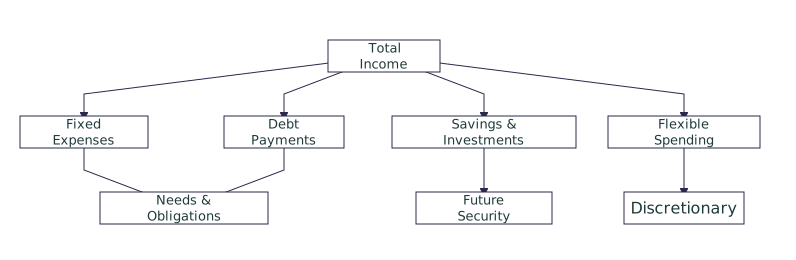
First, automation handles the priorities: $1,200 for Rent/Essentials, $300 for Debt, and $200 to Savings flow out immediately. That’s $1,700 total, automated and safe. The remaining $1,800 lands in your single Flexible Spending Pool.
This pool covers everything else: groceries, gas, dinners out, subscriptions, and random purchases. You don’t track “entertainment” vs. “dining.” You just spend from the pool. If it runs low with a week to go, you might choose simpler meals. If there’s money left over, it can roll over or go toward a fun treat. At your monthly check-in, you see the system worked: priorities were met, and you lived on the rest without stress. This is what a streamlined, easy budget system feels like—lightweight, clear, and adaptive to real life.
Your First Step Toward a Lighter Budget
The goal isn’t a perfect, color-coded spreadsheet. It’s a financial system that feels lightweight and actually works with your life, not against it. Simplification is a sophisticated strategy, not a lazy one.
Your next step is intentionally small and safe. Tonight, before the feeling fades, just list your 3-5 financial priorities. Don’t open your bank app, don’t analyze past spending. Just write them down. That single act begins the shift from a mindset of tracking to a mindset of protecting—which is the core of a budget that finally feels sustainable, not messy.